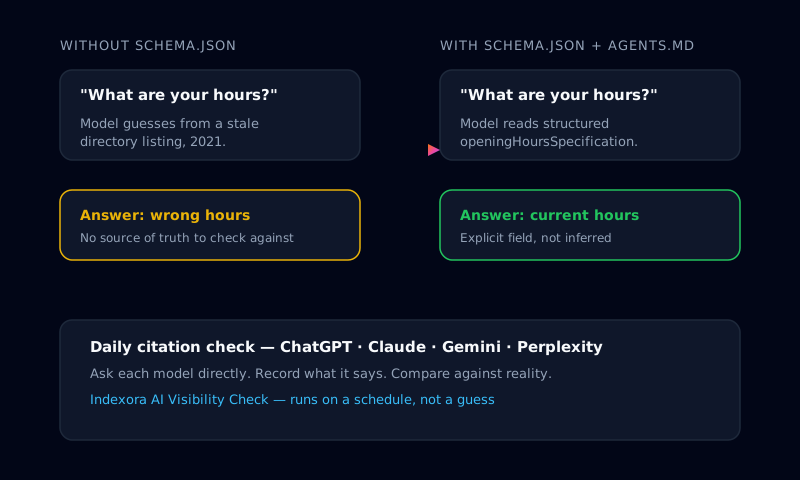
A customer asks ChatGPT what time a bakery closes on Sundays. The answer comes back instantly, confidently, and six months out of date. Nobody at the bakery knows this conversation happened. Nobody gets a chance to correct it before the customer shows up to a locked door.
That's the actual shape of this problem. Not an abstract "AI is unreliable" complaint. A specific, live misrepresentation of a real business, happening in front of a paying customer, with the owner given zero visibility into it. Indexora exists partly to close that particular gap, and it's worth understanding why it opens up in the first place.
Where the answer actually comes from
When someone asks an AI model about a business, the model isn't calling the business. In most consumer products (ChatGPT with browsing, Perplexity, Gemini) it's synthesizing from whatever got indexed: a cached version of the website, a directory listing nobody's touched since 2021, a Yelp page with outdated hours, or, in the base model's case, whatever existed in training data before its cutoff.
None of those sources are obligated to be current. A dentist's office that switched insurance networks eight months ago can still have three different AI answer engines citing the old provider, because that's what's sitting on an aggregator site nobody updated. The model doesn't know it's wrong. It has one plausible-sounding answer and no competing signal telling it otherwise.
Schema.org's LocalBusiness type has fields built exactly for this: openingHoursSpecification, priceRange, sameAs for tying together verified profiles. Most small business sites either don't implement it, or implement a partial version copied from a template three years ago and never revisited.
The same pattern shows up with services, not just hours. A landscaping company that dropped tree removal two years ago to specialize in irrigation still gets recommended for tree removal by AI answer engines, because an old service-area page or an aggregator listing never got pulled down and nothing newer told the model otherwise. The model isn't being careless. It's working from the most confident-sounding source available, and confidence isn't the same as correctness.
Having the information isn't the same as having it structured
Here's the part that trips people up: your hours might be correct, prominently displayed, right there in the footer of your homepage. That doesn't mean an AI crawler reliably extracts it.
Free-text scraping is inconsistent across different crawler and parsing stacks. A paragraph that says "We're open until 6 on weekdays, 4 on Saturdays, closed Sunday" is legible to a human in half a second and genuinely ambiguous to an automated parser trying to normalize it into a structured fact. JSON-LD markup exists specifically to remove that ambiguity. It's not prose to be interpreted, it's a field with a value.
This is what Indexora's schema.json generates: explicit LocalBusiness or Organization JSON-LD with your actual hours, address, phone, and service details in a format built to be machine-read rather than guessed at. Alongside it, agents.md (a newer convention functioning as the agent-layer equivalent of llms.txt) states plainly what a business does, what claims are accurate, and what an AI agent shouldn't say on its behalf. Cloudflare's Managed Agents and MCP-compatible agent frameworks already check for it. Most businesses have never heard of it, which means the interpretation of what they do is currently being left entirely to inference.
None of this requires a developer to hand-write JSON-LD correctly, which is its own small trap: a single malformed field in a schema block can make the whole object unparseable, silently, with no error shown anywhere on the live page. That's a common failure mode for sites that added schema manually years ago and never validated it since.
You can't fix what you never check
Publishing the right schema solves half the problem. The other half is that almost no business has a way of knowing whether ChatGPT, Claude, Gemini, or Perplexity currently say the right thing about them, or whether they're still repeating the exact error from eight months ago, unaffected by anything that's changed since.
That's not a one-time fix. Models get retrained, caches refresh on their own schedule, and a correction made today might not visibly propagate for weeks. The only way to actually know is to keep asking. Indexora's AI Visibility Check runs this as a recurring, scheduled query across all four major engines and records whether a domain is mentioned and what's being said about it, daily for paid subscribers, rather than leaving it as a periodic guess.
Check it yourself this week
Ask ChatGPT and Perplexity your own business name alongside one specific, checkable detail: a price, a service you no longer offer, a location you moved from. If either gets it wrong, that's not a hallucination to shrug off. It's a data gap with a fixable cause: nothing structured for the model to read instead of guessing. Publishing accurate schema markup and a business-identity file doesn't guarantee a model updates instantly, but it gives every future crawl something better than a stale directory listing to work from.
Frequently Asked Questions
Why does ChatGPT say the wrong hours for my business? ChatGPT and similar AI models rarely pull live data directly from your website. They draw from whatever was indexed or cached: an old directory listing, a stale Google Business Profile scrape, or training data with a cutoff date. If your site never gave a machine-readable, current source of truth, the model fills the gap with the most recent thing it has, right or wrong.
Can I correct what AI says about my business? You can't edit a model's output directly, but you can change what it has to work with. Publishing structured LocalBusiness or Organization schema, and a plain-language business-identity file like agents.md, gives AI systems a current, explicit, easy-to-parse source, which is what most consumer AI products prioritize over ambiguous prose scraped from a page.
What is agents.md and do I need it? agents.md is an emerging convention (the agent-layer equivalent of llms.txt) that tells AI agents specifically what a business does, what it should and shouldn't claim, and where its authoritative information lives. It's not required by any search engine, but frameworks like Cloudflare's Managed Agents and MCP-compatible agent tooling already look for it, and a business without one is leaving that interpretation entirely to guesswork.
How do I know if AI is citing my business correctly right now? The only reliable way is to actually ask: run the same question against ChatGPT, Claude, Gemini, and Perplexity on a recurring basis and check the answer against reality. Indexora's AI Visibility Check does this daily for paid subscribers and flags whether a domain is being mentioned and what's being said, instead of leaving it to chance.