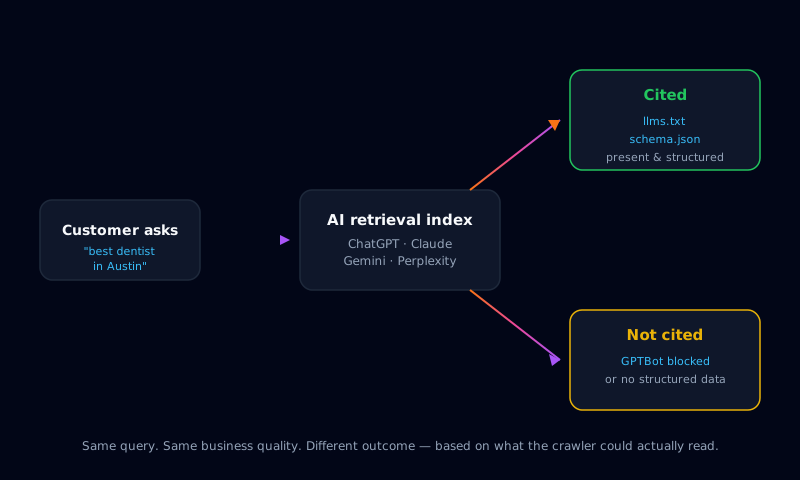
A dentist in Austin found out her practice doesn't exist to ChatGPT. Not delisted. Never seen. A colleague asked the AI "best emergency dentist near downtown Austin" as a test, and it named three competitors, then stopped. Her practice has better reviews, a newer building, and a website that's been live for six years.
She's not alone, and the reason isn't quality. It's that AI answer engines and traditional search engines find businesses through almost entirely different mechanisms, and most site owners have only ever optimized for one of them.
The AI doesn't read your site the way a person does
When ChatGPT, Perplexity, or Gemini answer a question about a local business, they're not rendering your homepage and skimming it the way a human visitor would. They're pulling from an index of pre-processed, chunked passages: smaller pieces of text and structured data that got extracted, embedded, and stored ahead of time. If your business's core facts (your services, your location, your hours, what makes you different) never made it into that extraction, there's nothing for the model to retrieve when someone asks.
This is why GPTBot, ClaudeBot, and PerplexityBot exist as distinct crawlers with their own user-agent strings. They're not just re-running Googlebot's job. They're building a separate index, optimized for retrieval and citation rather than link-based ranking.
Being blocked and being ignored look identical from where you're standing
Here's the part that catches most business owners off guard: a lot of security plugins and CDN firewalls block unfamiliar crawlers by default, and GPTBot, ClaudeBot, and PerplexityBot are unfamiliar to security rules written two or three years ago. The block throws no error. Nothing shows up in a support ticket. The AI crawler just quietly turns around at the door, every single time, and the business owner has no signal that it happened.
That's the actual problem underneath "why doesn't ChatGPT mention us." It's not usually that the business was evaluated and passed over. It's that nobody checked whether the door was open in the first place.
What actually gets cited
AI engines have a strong preference for structured, unambiguous data over prose they have to interpret. Three files do most of the work:
llms.txt: a plain-text summary written specifically for language models, distinct from the marketing copy on your homepage. It states what the business does, where, and for whom, in a format that doesn't require the model to infer anything.
schema.json: JSON-LD structured data that defines your business as a named entity: address, hours, services, contact details, in a format search and AI systems can parse without ambiguity.
A crawler-aware robots.txt: one that explicitly allows GPTBot, ClaudeBot, PerplexityBot, and Google-Extended, rather than relying on a generic Allow: / written before those crawlers existed.
None of this is exotic. It's closer to giving the AI a clean, labeled filing cabinet instead of a room full of loose paper and expecting it to guess which pile matters.
Ranking #1 on Google and still getting zero AI citations is common, not rare
This is the counterintuitive part: SEO and AI visibility are not the same discipline, and doing well at one tells you almost nothing about the other. Traditional SEO rewards backlinks, page speed, and years of accumulated authority. AI citation rewards whether your specific facts got extracted into a retrievable, structured form. A site can dominate page one of Google and never appear in a single AI-generated answer, because the retrieval pipeline that feeds those answers never picked it up.
Check this today, not eventually
Open ChatGPT, Perplexity, and Gemini in three tabs. Ask each one the exact question a real customer would type: "best [your category] in [your city]," or whatever your actual buying query looks like. Read whether you're named, and if a competitor is, notice what language the AI used to describe them. That's usually lifted straight from the competitor's own structured data.
A single check tells you where you stand today. It doesn't tell you whether a fix is working next month. That requires checking again, and again, on a schedule, which is the part most people give up on manually. Indexora's AI Visibility Check runs this exact query daily across ChatGPT, Claude, Gemini, and Perplexity for domains on a paid plan, so the answer to "did we get cited this week" doesn't depend on remembering to ask.
Frequently Asked Questions
How do I know if ChatGPT or Perplexity mentions my business? Ask each engine a query a real customer would use, such as "best [your category] in [your city]," and read the answer closely. Do this once and you get a snapshot. Do it daily and you get a trend, which is the only way to know if a fix actually worked.
Does ranking well on Google mean I'll show up in AI answers too? No. Google ranking depends on backlinks, behavioral signals, and decades of crawl infrastructure. AI answer engines extract and cite specific structured passages, often pulled from a much smaller indexed subset of the web. A page can rank first on Google and never get chunked into an AI engine's citation index.
What files actually help AI engines cite my business correctly? llms.txt (a plain-text summary written for language models), schema.json (structured JSON-LD describing your business as an entity), and an AI-crawler-aware robots.txt that explicitly allows GPTBot, ClaudeBot, and PerplexityBot. Without these, engines are guessing at your business from whatever fragments of your normal HTML they managed to parse.
Can an AI crawler be blocked without me knowing? Yes. Many security plugins and CDN configurations block unfamiliar user agents by default, and GPTBot, ClaudeBot, and PerplexityBot are unfamiliar to a lot of older security rules. The block produces no error message to the site owner. The AI crawler is simply turned away, silently, every time.