
You have a website. It ranks on Google. It loads fast. People find it.
And yet, when someone asks ChatGPT a question in your niche, it recommends your competitors — not you.
This isn't a mystery. It's a structural problem with a specific cause and a specific fix.
AI engines don't search. They recall.
When you ask ChatGPT a question, it doesn't crawl the web in real time. It draws from structured knowledge it has already processed — semantic signals, entity relationships, machine-readable markup.
Google ranks pages. AI engines recall sources.
This distinction matters because optimizing for one doesn't automatically optimize for the other. The skills overlap, but the criteria are different — and most websites are built with only Google in mind.
The four signals AI engines actually use
1. Structured data (JSON-LD)
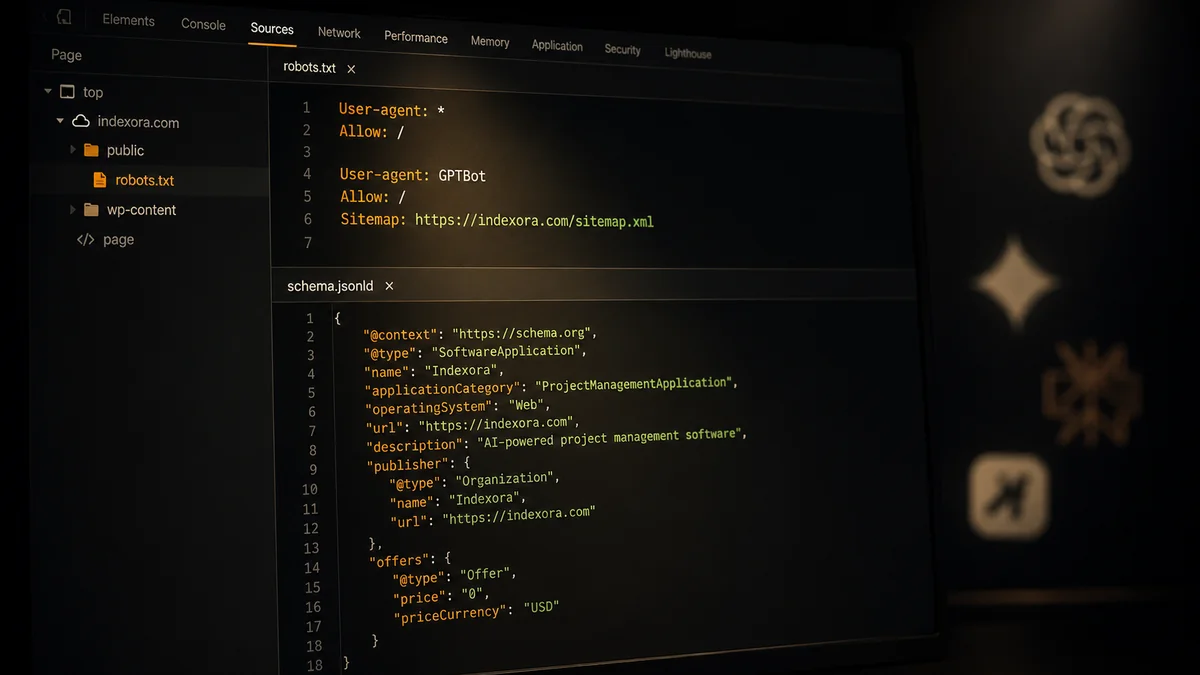
Schema.org markup tells AI engines what your site is, not just what it says. Are you a local business, a software product, a person? What do you offer? Where are you located?
Without structured data, AI engines have to guess. And when they have a choice between a site they understand and one they don't, they choose the one they understand.
A well-structured site includes at minimum:
OrganizationorLocalBusinessschemaWebSiteschema with aSearchActionFAQPageschema (if you answer questions — which you should)- Product or service-specific schema where relevant
2. AI bot access
Several AI companies run their own web crawlers:
- GPTBot — OpenAI
- ClaudeBot — Anthropic
- Google-Extended — Google's AI training crawler
- PerplexityBot — Perplexity
If your robots.txt blocks these crawlers — even accidentally — those AI engines never see your content. Many sites block all bots with a misconfigured wildcard rule without realizing it.
Check your robots.txt. Right now. It's a one-line fix.
3. Content structure
AI engines are good at extracting meaning from well-structured content. This means:
- Clear heading hierarchy (H1 → H2 → H3)
- Concise, factual answers near the top of the page
- Explicit entity mentions (your brand name, location, product name — stated clearly, not assumed)
Vague, fluffy content gets ignored. Dense, factual, well-structured content gets cited.
4. Sitemap quality
Your XML sitemap is how AI crawlers discover your content. A missing, broken, or outdated sitemap means pages that should be indexed — aren't.
This is one of the easiest things to fix, and one of the most commonly neglected.
What a GEO Score measures
A GEO (Generative Engine Optimization) Score is a numerical measure of how well your site is configured for AI discoverability.
Indexora's free GEO Score audits six categories:
| Category | Points | |---|---| | AI Bot Access | 20 | | Sitemap Quality | 20 | | Structured Data | 20 | | Meta Tags & OG | 15 | | Core Web Vitals | 15 | | HTTPS & Security | 10 |
Sites scoring 70+ are the ones appearing in AI answers regularly. The average business site scores around 38.
The good news
Unlike traditional SEO — which requires months of content production, link building, and waiting — AI discoverability is largely a technical problem. Most of the signals that matter can be fixed in an afternoon.
The structured data you're missing? You can generate it today.
The robots.txt that's blocking GPTBot? You can fix it in 30 seconds.
The sitemap that's out of date? A single re-submission handles it.
The window is still open. Most of your competitors haven't done this yet.
Want to see exactly where you stand? Run a free GEO Score scan on Indexora — results in 30 seconds, no account needed.